
Dwarf gouramis are one of the most-recommended community-tank fish in the UK aquarium trade. Colourful, peaceful, small enough for a 60L tank, and available in every high-street pet shop. They’re also — and this is what the shops don’t tell you — badly affected by an incurable viral disease that kills a large percentage of commercially-produced stock within months of purchase.
This guide covers proper care for the ones that survive, and the buying strategy that dramatically improves your odds of getting healthy fish. It’s the honest UK-focused version of dwarf gourami care in 2026.
This article contains affiliate links. If you buy through one of them, FishForever earns a small commission at no cost to you. We only recommend products we’d use ourselves. See our Affiliate Disclosure.
- Dwarf gouramis (Trichogaster lalius) reach 6–8 cm and suit a 60-litre-plus tank with gentle flow and floating plants.
- A large share of farmed stock carries incurable Dwarf Gourami Iridovirus — buy from reputable shops and quarantine for 6 weeks.
- Keep only one male per tank; males fight.
- Honey gouramis are a hardier, lower-disease-risk alternative.
Quick facts
- Scientific name: Trichogaster lalius (older: Colisa lalia)
- Origin: Northern India, Bangladesh — slow-moving rivers, rice paddies, ponds
- Adult size: 6–8 cm
- Lifespan: 3–5 years in good conditions (many captive fish only make 1–2 years due to disease)
- Water temperature: 24–28°C
- pH: 6.0–7.5
- Water hardness: soft to medium (4–15 dGH)
- Minimum tank size: 60L for a single male
- Social: males aggressive toward each other; buy ONE male per tank or a pair (M/F).
Colour varieties available in UK shops
All the same species; selective breeding for colour:
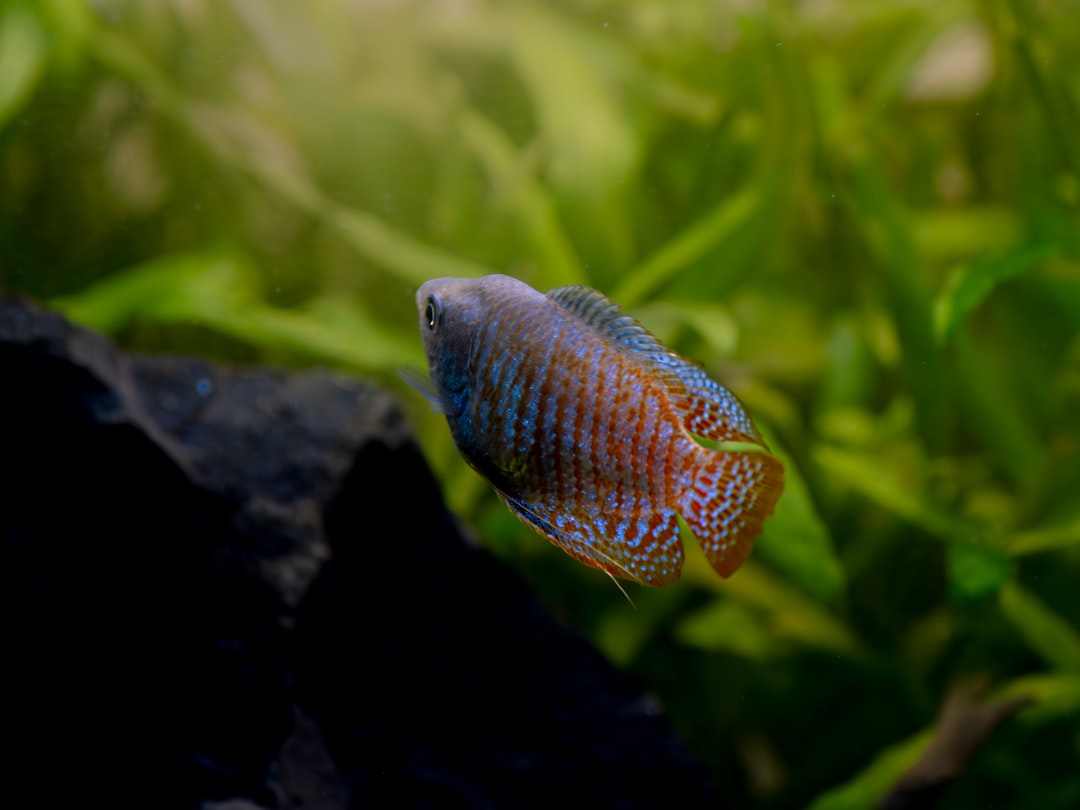
- Standard dwarf gourami — reddish body with blue-turquoise vertical stripes
- Powder blue dwarf — solid pale blue males
- Flame (neon) dwarf — vivid red/orange males with less blue
- Honey gourami (technically a different species, Trichogaster chuna) — usually smaller and hardier
Females of any variety are noticeably drabber — silvery-grey with faint stripes. Sexing is trivial from about 5cm.
The disease warning (read this first)
Dwarf Gourami Iridovirus (DGIV) is a viral disease that affects a substantial percentage of commercially-farmed dwarf gouramis. Symptoms typically appear 6–8 weeks after purchase and include:
- Loss of appetite, thinning body
- Ulcers on body and fins
- Lethargy, clamped fins
- Colour fading
There is no cure. Affected fish die within weeks; the virus can spread to other gouramis in the tank.
How to minimise risk:
- Buy from reputable independent aquatic shops — Maidenhead Aquatics, specialist UK aquascape shops. Avoid big-box pet chains where turnover is fast and stock quality is poor.
- Quarantine for 6+ weeks in a separate tank before adding to your main tank. If the fish develops symptoms, you’ve saved the rest of the community.
- Consider honey gouramis instead (Trichogaster chuna) — same size, similar temperament, dramatically lower DGIV rate.
- Ask the shop where the fish were bred — UK/European-bred stock has lower DGIV rates than Southeast-Asian farmed imports. Some shops will know; most won’t.
None of this eliminates the risk. Buy one male dwarf gourami expecting a 40–60% chance of it living past 6 months. Don’t stock a tank around it before it’s clearly stable.
Tank setup
Tank size
- Single male: 60L minimum
- Male + female pair: 90L minimum
- Bigger is better — 90L for a single male gives room for hiding when he needs it
Filtration
Dwarf gouramis dislike strong flow. They come from slow-moving rivers and rice paddies. Good options:
- Sponge filter with air pump — perfect gentle flow
- Small internal filter with flow turned down
- Canister filter with spray bar diffusing the current across the back wall
Avoid: powerheads, strong outflow directly into swimming areas, wave-makers.
Heater
Dwarf gouramis need warm water year-round. See our best aquarium heater UK 2026 guide. For a 60L tank at 26°C: 50W Fluval E100 or Aquael Ultra 50W.
Plants — non-negotiable
Dwarf gouramis are labyrinth fish that surface-breathe and prefer densely-planted tanks with floating plants overhead. Their natural instinct is to hide in vegetation.
Ideal plants:
- Amazon frogbit or other floating plants — shade the tank, provide surface cover, males use them for bubble nests
- Java fern and Anubias — for hiding in the mid-water
- Vallisneria or Cryptocorynes — mid-to-background rooted plants
See our best aquarium plants for UK beginners for setup detail.
Substrate and hardscape
Fine gravel or dark sand. Add aquarium bogwood or spider wood — leaches tannins that dwarf gouramis appreciate. Indian almond leaves also welcomed.
Water chemistry
Cycle the tank properly first — see our UK cycling guide. Then target:
- Ammonia / Nitrite: 0 (always)
- Nitrate: under 30 ppm
- pH: 6.5–7.5, stable
- Hardness: soft to medium (4–15 dGH)
- Temperature: 25–27°C, stable
UK soft-water areas suit dwarf gouramis perfectly. Hard-water areas can adjust with peat filtration or Indian almond leaves — see our how to lower pH guide.
Test weekly with an API Freshwater Master Test Kit.
Feeding
Omnivorous with a slight preference for animal protein.
Daily options:
- Hikari Micro Wafers or Tetra Prima — small floating/sinking pellets
- Standard flake food
- Vegetable-based flake (spirulina, algae) as some plant content
Treats 2–3× a week:
- Frozen bloodworm
- Frozen brine shrimp
- Live daphnia if you can source them
Feed twice a day, only what fish clear in 2 minutes.
Tank mates
Dwarf gouramis are peaceful with most community fish but with a few caveats:
Good tank mates:
- Small tetras — neons, cardinals, ember, rummy-nose
- Rasboras — harlequins, chili rasboras
- Corydoras catfish — bottom-dweller, no competition
- Otocinclus catfish — peaceful algae eaters
- Bristlenose plecs — bottom-dwellers
- Kuhli loaches — bottom-nocturnal
- Snails — safe, though gouramis may eat baby snails
Avoid:
- Multiple male dwarf gouramis in one tank — they fight, sometimes to death. One male only per tank.
- Betta fish — territorial conflict with dwarf gouramis; both are anabantoids and view each other as rivals
- Fin-nipping fish — tiger barbs, some serpae tetras, giant danios
- Aggressive cichlids — anything larger than rams
Sexing
By 4–5 cm:
- Male: deep body, vivid colours (reds/blues), pointed dorsal fin
- Female: silvery-grey, rounder body, rounded dorsal fin
Male dwarf gouramis are what UK shops sell almost exclusively — females are drab and don’t sell as well. If you want a breeding pair you’ll usually need to specifically ask the shop to order females.
Breeding
Dwarf gouramis are bubble-nest builders — one of the more interesting fish to breed.
Setup:
- Species-only tank, 40L+ with lots of floating plants and cover
- Water temperature raised to 28°C
- Water level lowered to 15–20 cm depth
- Pair of adult male + female, well-fed on live/frozen food for 2 weeks
Process:
- Male builds a bubble nest under floating plants
- When ready, he entices the female under the nest
- Spawning happens — female releases eggs, male fertilises and catches them, spits them into the nest
- Remove the female immediately after spawning — male becomes aggressive
- Male guards the nest for 24–36 hours until eggs hatch
- Fry emerge with yolk sacs; free-swimming after 3–4 days
- Remove the male once fry are free-swimming, or he’ll eat them
- Feed fry on infusoria/liquid fry food for the first week, then baby brine shrimp
Fry are tiny — smaller than most livebearer fry. Slower to grow (3–4 months to sale size).
Common problems
Sudden colour fade + lethargy + weight loss — early Dwarf Gourami Iridovirus. No treatment. Isolate and euthanise humanely to prevent spread.
Fin damage / rot — usually aggression from a tank mate. Identify and remove aggressor. See our fin rot guide.
Hanging near the surface, breathing rapidly — poor water quality or low oxygen. Test water, do a water change.
White fluff on body — fungus, usually secondary to injury or poor water. Treat with NT Labs Anti-Fungus or Waterlife Myxazin.
Two males in one tank fighting — separate immediately. One will be badly injured or killed within days.
Honey gouramis — the safer alternative
If DGIV risk sounds unacceptable, honey gouramis (Trichogaster chuna) are the pragmatic alternative:
- Same peaceful temperament
- Smaller (5cm adult)
- Same care requirements
- Much lower DGIV rates
- Available at most UK aquatic shops
- Slightly less flashy colouring (golden-yellow rather than red/blue)
For a community tank in the 60L+ range, honey gouramis over dwarf gouramis is often the smarter choice.
Bottom line
Dwarf gouramis are beautiful but their commercial supply chain is unreliable. Buy one healthy specimen from an independent aquatic shop, quarantine for 6+ weeks, and accept that 40–60% chance you’ll lose it to DGIV within 6 months regardless of care quality.
If that risk is unacceptable, buy a honey gourami instead — you get 80% of the aesthetic value with a fraction of the disease risk.
For the ones that thrive, they’re one of the most personable community-tank fish — surface-feeders that recognise the person feeding them, build bubble nests, and interact visibly with tank mates.
Frequently asked questions
What size tank does a dwarf gourami need?
At least 60 litres for one male, or 90 litres for a male-and-female pair. They prefer gentle flow and densely planted tanks with floating cover.
Why do dwarf gouramis die so easily?
Many farmed dwarf gouramis carry incurable Dwarf Gourami Iridovirus, which kills them within months. Buy from reputable shops, quarantine for six weeks, or choose hardier honey gouramis.
Can you keep two dwarf gouramis together?
Only one male per tank — males fight, sometimes to the death. A single male, or a male with females in a larger tank, works best.
Related: best aquarium fish for UK beginners, betta fish care (also a labyrinth fish, similar setup), best aquarium heater UK, best aquarium plants UK.
— Jaqline Smalling, FishForever
Leave a Reply