
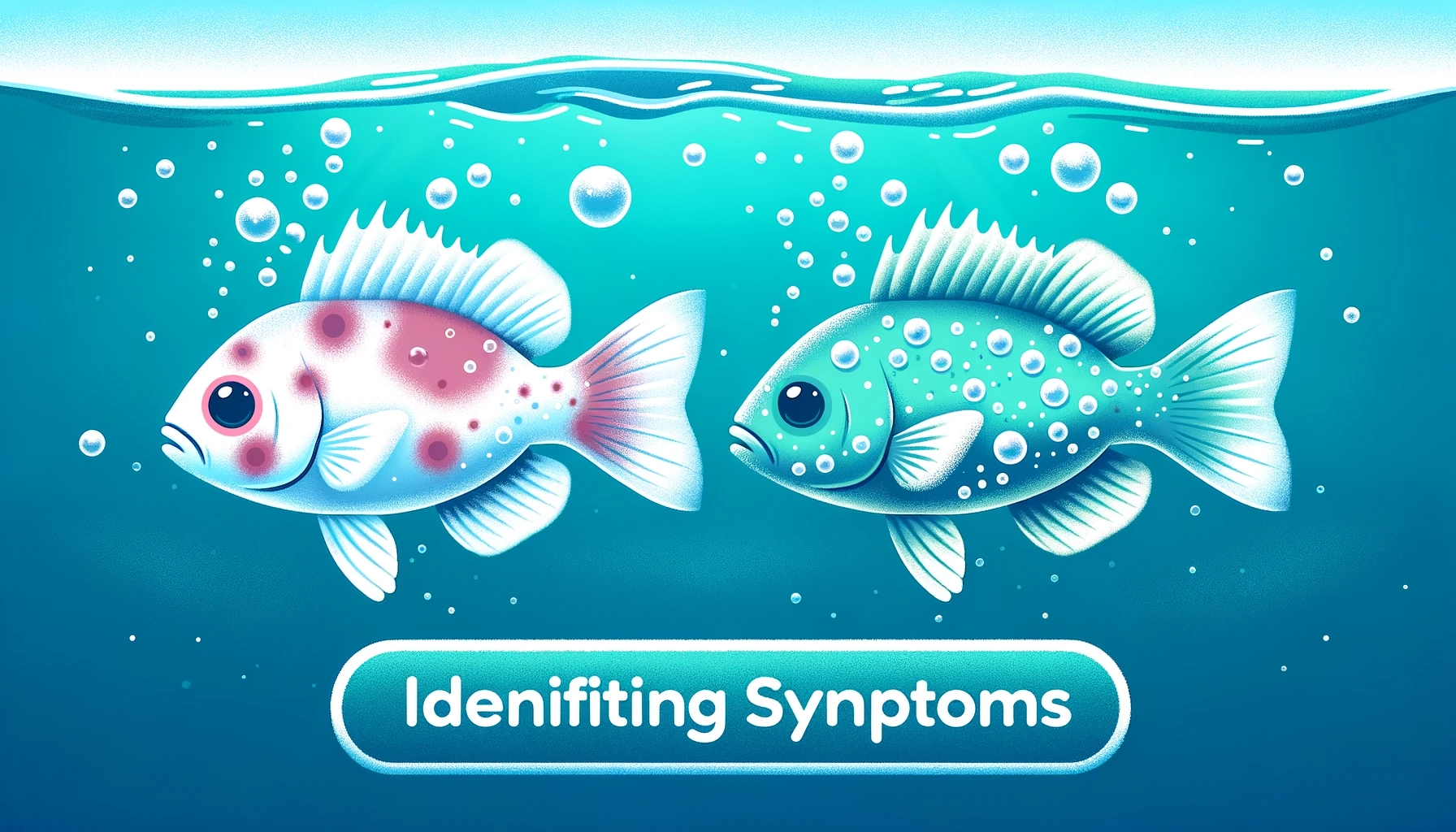
If a fish in your tank suddenly looks as though someone has salted it — pinhead-sized white specks scattered across the body, fins clamped, breathing faster than it should — you’re almost certainly looking at ich. It’s the most common disease in the freshwater hobby, and it kills more fish per year than every other disease combined.
The good news: ich is treatable, cheaply, without expensive medications, if you understand its life cycle. The bad news: most beginners treat the wrong stage and lose the fish anyway.
This guide walks you through identification, the treatment protocol we actually use ourselves, and what to do differently for sensitive species like catfish, loaches, and scaleless fish.
This article contains affiliate links. If you buy through one of them, FishForever earns a small commission at no cost to you. We only recommend products we’d use ourselves. See our Affiliate Disclosure.
What ich actually is
Ich — properly Ichthyophthirius multifiliis — is a ciliated protozoan parasite. It has three life stages, and you can only kill it in one of them.
Trophont (the stage you can see). The parasite burrows under the fish’s skin, eats tissue and blood, and grows into the pinhead-white cyst you see on gills, fins and flanks. Medicines cannot reach it here; the fish’s own mucus protects the parasite.
Tomont (the reproductive stage). After a few days feeding, the trophont drops off the fish, sinks to the substrate, and encapsulates itself. Inside the cyst it divides — up to 1,000 daughter parasites per adult.
Theront (the free-swimming infective stage). The cyst bursts, releasing hundreds of tomites that swim through the water looking for a fish. This is the only stage you can kill. They must find a host within about 24 hours or they die.
The whole cycle runs about 10 to 14 days at 26 °C, faster in warmer water, months slower in colder water. Which means: temperature is your treatment lever.
How to identify ich
- White specks, typically the size of a grain of salt, on fins, body and gills. Distinguish from air bubbles (which vanish overnight) and from tuberculosis (which produces raised nodules, not specks).
- Fish “flashing” — swimming into rocks or substrate to scratch. This starts before you see spots.
- Clamped fins — held tight against the body.
- Rapid gill movement, gasping at the surface — the parasite has invaded gill tissue.
- Loss of appetite, hiding, general listlessness.
Ich almost never appears from nowhere. It comes in on new fish, new plants, or on equipment shared between tanks. The single biggest source in the UK is buying fish from a display tank where you’ve spotted one already-infected fish. That’s not a “hardy-fish-only-affected” tank — the parasites are in the water everyone came home in.
The treatment protocol
There are two approaches. Pick one; don’t mix them.
Approach A: heat + salt (the safe default for most tanks)
Works for community tanks with hardy fish. Cheap, gentle, no medications required.
Step 1. Raise the temperature to 30 °C over 12–24 hours. Don’t dump it up in one go — half a degree per hour is fast enough. Higher temperature speeds the parasite’s life cycle, forcing it out of the “invulnerable” trophont stage sooner.
Step 2. Add aquarium salt at a rate of 1 tablespoon per 20 litres (about a teaspoon per 6 litres). Use proper aquarium salt or non-iodised table salt — never marine salt for freshwater tanks. Dose it dissolved in a jug of tank water, added over a few hours, not sprinkled straight in.
Step 3. Add an air stone or turn up your filter’s spray-bar. Warm water holds less dissolved oxygen, and stressed fish need more of it. This step gets skipped and fish die of asphyxia while their owners think it’s ich killing them.
Step 4. Daily 25% water changes for 14 days. Vacuum the substrate thoroughly each time — tomont cysts hide in the gravel. Replace the salt you remove (25% of tank volume × dose = amount to redose).
Step 5. Keep the treatment running for 14 full days, minimum, even if visible spots disappear after 3–4 days. The trophonts you can see are only half the population; the rest are in the substrate cycling through. Stop early and it comes right back.
Step 6. After day 14, cool the tank back to normal (26 °C is fine for most tropicals) over 24–48 hours. Water-change out the salt over a further week.
Approach B: medication (for scaleless / sensitive tanks)
If your tank contains catfish (Corydoras, plecos, ancistrus), loaches (kuhli, clown, weather), scaleless fish generally, or very small tetras, do not use full-dose salt. Their skin cannot handle it and you’ll lose them faster than the parasite would.
Use a proprietary ich medication instead. In the UK the reliable options are:
- Waterlife Protozin — malachite-green plus formaldehyde blend, dosed daily for 4 days. Effective on scaleless fish at the standard dose. About £8 for a 100ml bottle, treats around 400 litres.
- NT Labs Anti-White Spot & Fungus — a UK-formulated product widely stocked by independent aquatic shops. Malachite-green based, ¼–½ dose for scaleless fish, full dose for scaled.
- eSHa EXIT — Dutch, popular UK-side. Full dose for community tanks, half dose for tetras/corys.
Remove carbon from your filter before treating (activated carbon strips medications from the water within hours). Increase temperature to 28 °C — high enough to speed the cycle, low enough to be safe with medications. Dose according to the label; over-dosing does not work faster and will kill fish.
Water-change nuance during treatment
Big water changes during medicine treatment dilute the meds and reset the dose clock. Do a large water change once between doses, at the manufacturer’s recommended interval (typically day 3 or day 5), then re-dose to full strength. With salt-and-heat treatment, daily small changes are the norm because you’re removing waste and freed parasites; you re-add the salt each time.
Never do a big water change with room-temperature UK tap water into a 30 °C tank. Fill a bucket, warm it with an old aquarium heater to match, then transfer. Cold shock is a stress-killer.
What “cured” looks like
- No visible spots for 7 consecutive days.
- Fish resume normal feeding and swimming.
- No flashing or clamping.
Only then is it safe to stop treatment. Return the tank to normal parameters over a week, do a big water change to strip remaining medication or salt, and put carbon back in the filter if you removed it.
How not to get ich again
Ich is a mistake-prevention disease. Once you’ve had it, you’ll never let it in again if you do these things.
- Quarantine new fish for 3 weeks. A 40-litre spare tank with a sponge filter is enough. If ich shows in quarantine you treat there; if it never shows, they graduate to the main tank clean.
- Buy from shops with visibly healthy stock only. If you can see even one fish with ich in a shop’s system, walk out. Their tanks are usually shared water.
- Dip plants in a mild potassium permanganate solution before adding to the main tank (10 mg/l for 30 minutes, then rinse thoroughly). Ich can travel on plants.
- Never share nets, siphons or equipment between tanks. Or if you do, rinse in hot water and dry completely between uses.
- Keep stress low. Ich lives in aquarium water at low levels almost constantly. Healthy, low-stress fish with strong slime coats suppress it. Overcrowded, cold, or poorly-fed fish do not.
When you can’t beat it
Occasionally you get a strain that survives standard treatment. If after 21 days of proper protocol the spots are still coming, you’re either treating at the wrong temperature (many old heaters can’t actually maintain 30 °C in a cold UK garage) or the strain is resistant.
At that point the options are:
- Escalate to a stronger malachite green + methylene blue combination (Sera Costapur, for example) at short-term high concentration.
- Do a “chase” treatment: raise to 32 °C for 4 days on top of the medication. This kills nearly every strain but stresses fish severely — only for tanks of hardy species.
- If you’re seeing repeated ich flare-ups on the same fish (usually one specific fish, always the same one), that individual may be immunocompromised. Rehoming it saves the rest of the tank.
A last note
Ich is only fatal because it goes undetected until it’s advanced. If you check your fish once a day and catch it in the first 48 hours — one or two visible spots — the salt-and-heat protocol has a survival rate close to 100 percent. If you catch it at day five with fish already gasping at the surface, expect to lose some. The habit worth building is a two-minute check every evening at feeding time. Ich never survives a hobbyist who looks.
Products mentioned in this article
Amazon UK links. Prices and stock change; we recommend checking a couple of independent UK aquatic shops for comparison before buying.
Prevention starts with cycling your tank properly — see our UK guide to cycling a fish tank. If you’re not sure what’s on your fish, read the broader fish disease symptoms overview first. Setting up a quarantine tank is a common request — we’ll cover that separately.
— Jaqline Smalling, FishForever
Leave a Reply