
If you asked us to name the single hardiest tropical fish for a UK beginner community tank, the zebra danio would win almost every time. Inexpensive and widely stocked in UK aquatic shops, astonishingly tolerant of water-quality mistakes, active, cheerful, and — if you keep enough of them — genuinely entertaining to watch. They’re the fish first-tank owners should be sold before anyone even mentions neon tetras.
The name is more familiar than the species. Zebra danios were until fairly recently classified as Brachydanio rerio; they’ve since been moved to Danio rerio — the same fish, just tidier taxonomy. They’re also one of the most-studied vertebrates on Earth, because the same qualities that make them robust in a home aquarium make them ideal laboratory animals: they breed on schedule, tolerate variable conditions, and their embryos are transparent for developmental biology.
This article contains affiliate links. If you buy through one of them, FishForever earns a small commission at no cost to you. We only recommend products we’d use ourselves. See our Affiliate Disclosure.
- Zebra danios (Danio rerio) are the hardiest tropical fish for UK beginners — adults reach 4–5 cm and tolerate 18–26 °C.
- Keep them in shoals of 6 or more (8+ is better) in a tank of at least 60 litres.
- They are jumpers — a lid is essential.
- They prefer the cooler end of the tropical range and actually live longer at 22–24 °C than at 27 °C+.
Quick facts
- Scientific name: Danio rerio
- Common names: Zebra danio, zebrafish, striped danio
- Origin: South Asia — Bangladesh, India, Nepal, Pakistan, Bhutan
- Adult size: 4–5 cm
- Lifespan: 3–5 years typical; up to 7 in exceptional care
- Water temperature: 18–26 °C (broader tolerance than most tropicals)
- pH: 6.5–8.0
- Water hardness: Soft to hard (5–20 dGH). Tolerates typical UK tap water anywhere in the country.
- Minimum tank size: 60 litres for a shoal of six
- Ideal shoal size: 8+ (they need company; a lone danio is a stressed danio)
Tank setup
Zebra danios are shoaling, active swimmers. Everything about their tank should serve that.
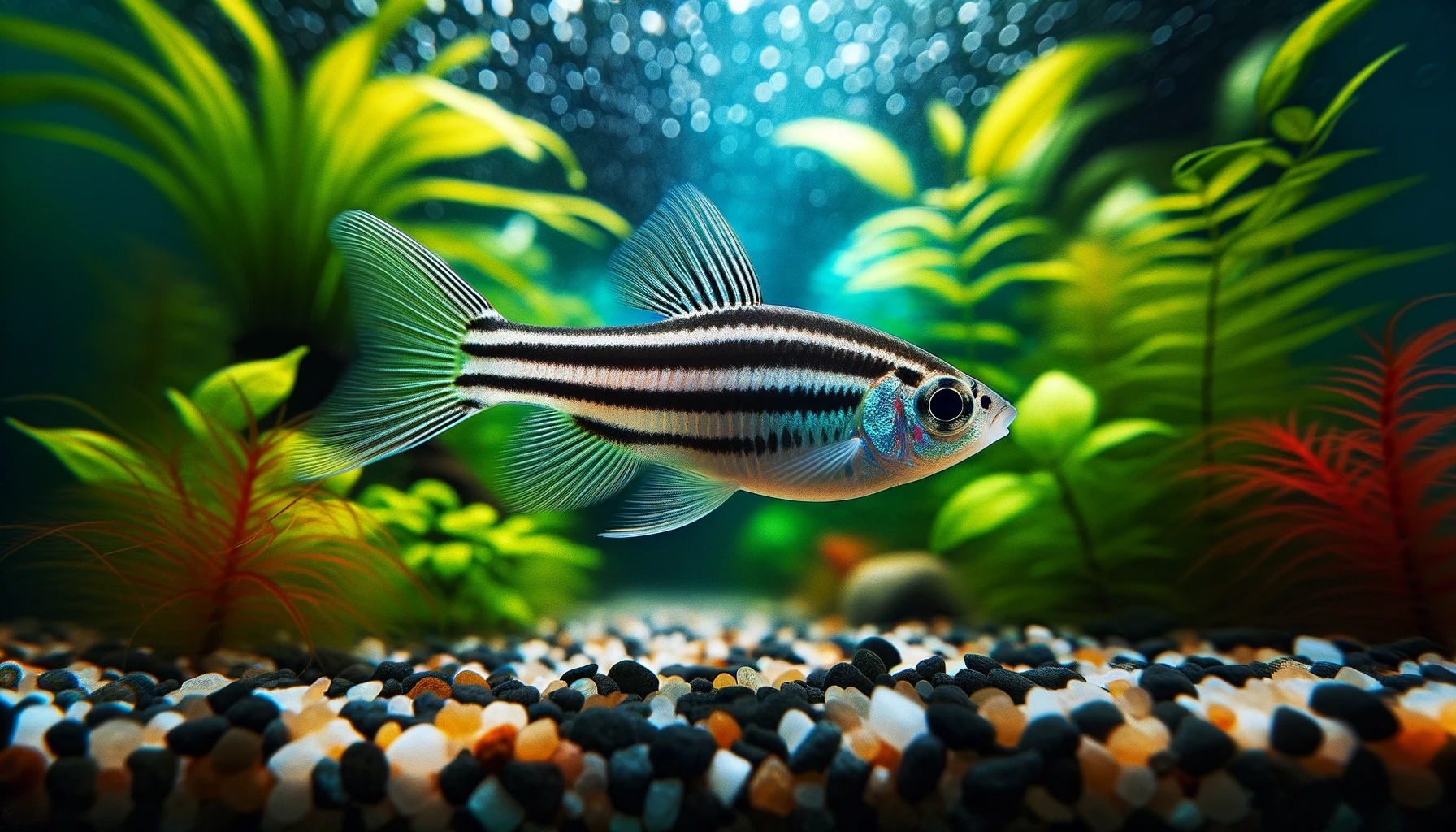
Length matters more than volume. A long, shallow tank — 60 litres in a 60cm-long tank — beats a taller cube of the same volume. Danios want swimming distance.
Filtration and flow. Zebra danios evolved in streams and rice-paddy runoff and enjoy moderate flow. A standard internal or external filter set to point along the long axis of the tank produces the current they like. If your tank is too still, you’ll see them shoaling tightly against the filter outflow — that’s the tell that they want more current.
Substrate. Fine sand or small gravel. Doesn’t matter to them either way.
Planting. Tolerant of any plant setup — heavily planted, open swimming areas, mixed. They breed better with dense fine-leaved plants at the bottom (Java moss, hornwort) because eggs fall into them out of reach of hungry parents.
Cover. A lid or a low water level. Zebra danios are jumpers. Small ones can get through openings you wouldn’t credit.
Water parameters
Cycle the tank properly first — our UK cycling guide covers it. After that, zebra danios are close to bulletproof:
- Ammonia: 0 ppm (always)
- Nitrite: 0 ppm (always)
- Nitrate: under 40 ppm — they tolerate higher than most tropicals but higher stresses them long-term
- Temperature: anywhere in the 18–26 °C range. They handle drops overnight better than most tropicals, which makes them survivors in the UK during heating failures. Do not push them above 27 °C long-term — they’re actually a temperate fish being sold as tropical.
The temperature note above is important. Many UK aquatic shops keep tropical tanks at 26–28 °C. Zebra danios in those tanks are being kept at the top of their comfortable range and typically die younger than they should. If you keep an unheated tank at around 20 °C in a warm room, danios thrive.
Sexing
By 4 months old:
- Male — slimmer body, tighter horizontal stripes, faint gold/yellow tint on the belly and between stripes.
- Female — broader, deeper belly (especially when carrying eggs), silvery-white belly, stripes appear slightly broader because the body is broader.
Both sexes have the same 4–5 dark horizontal stripes running the length of the body. In the longfin variety, both sexes have flowing dorsal and caudal fins, so fin shape doesn’t help with sexing.
Feeding
Omnivorous. In an average community tank, standard flake makes up most of the diet. Vary it:
- Standard flake food (Tetra Prima, JBL NovoTom, Hikari Micro Wafers) — daily
- Frozen or freeze-dried bloodworm — 2× a week as a treat
- Frozen daphnia — helps condition females for breeding
- Vegetable content — algae wafers, blanched pea occasionally
Feed twice daily, only what they eat in two minutes. Zebra danios are surface-and-mid-water feeders and will grab flakes before they sink — so bottom-feeding tank mates don’t compete with them for food.
Tank mates
Peaceful, non-aggressive, and safe with almost every UK community-tank species. Compatible with:
- Other danios — pearl danios, giant danios (bigger tank needed), leopard danios (colour variant)
- Tetras — neons, cardinals, black neon, ember, glowlight, all standard community tetras
- Rasboras — harlequin, chilli, lambchop
- Corydoras catfish — happy bottom-dwelling companions
- Bristlenose plecos — as we covered in the ancistrus guide
- Livebearers — guppies, endlers, mollies, platies, swordtails
- Ghost shrimp and cherry shrimp — as covered in the ghost shrimp guide
- Otocinclus catfish
- Kuhli loaches
Avoid: anything predatory or aggressive (angelfish are borderline — mature angels sometimes hunt fast-moving small fish), bettas (danios stress bettas out with their constant motion), and very slow-moving long-finned species (danios sometimes nip at trailing fins).
Do not keep them alone or in pairs. Groups of six is the absolute minimum. Groups of eight or more is where they behave naturally.
Breeding
Genuinely easy. Zebra danios are among the first fish most hobbyists successfully breed. The process:
- Condition a group of 4–6 for a week on live or frozen food (bloodworm, daphnia). Well-fed females fill out visibly around the belly.
- Set up a breeding tank — 20-litre bare-bottom, layer of marbles on the base (or a mesh with holes small enough for eggs to fall through but too small for adults to enter). Alternative: heavy layer of Java moss on the bottom.
- Add the parents in the evening, 1 male per 1–2 females, and lower the temperature by 2–3 °C. Cool water mimics the rainy season and triggers spawning.
- Turn the lights on at dawn. Spawning happens in the first hour, often before you’re even up. Females scatter eggs; males fertilise them as they fall.
- Remove the parents before breakfast. They will eat any eggs they can find.
- Eggs hatch in 24–36 hours at 24 °C.
- Fry hang on tank surfaces for another 3–4 days, absorbing yolk sacs. Then they start free-swimming.
- Feed fry on infusoria, powdered fry food, or (best) newly-hatched brine shrimp from day 5.
A single spawn can produce 100+ fry. Reasonable survival rates are 40–70%. Fry reach sale size (2 cm) in about 3 months.
Most UK aquatic shops will take healthy fry as store credit. Zebra danios have little resale value, but the sale route exists.
Common problems
Fish jumping out. Cover the tank. All danios jump. Zebra danios are particularly notorious. Even a small gap around a filter cable is enough.
Fish gasping at the surface constantly. Either water is too warm (over 27 °C) or oxygen is low (algae bloom overnight, filter failure). Test water, adjust temperature, ensure surface agitation.
Fish thin and hollow-bellied despite feeding. Internal parasites, usually camallanus worms (visible as tiny red threads protruding from the vent) or fish tuberculosis. Treat with a UK antiparasitic (NT Labs Anti-Internal Parasite, eSHa NDX). Tuberculosis has no reliable cure — humane euthanasia is the responsible choice.
Fin nipping. Zebra danios sometimes nip at long-finned tank mates when they’re kept in groups smaller than 6. The fix is more danios, not fewer.
The GloFish situation
You may see fluorescent-coloured zebra danios sold as “GloFish” in some markets. These are genetically modified zebrafish with jellyfish or coral fluorescence genes inserted. In the United Kingdom, sale of GloFish is not currently permitted — GM organisms fall under Defra regulation and haven’t been approved for the aquarium trade. Any GloFish you see for sale in the UK are being sold in breach of regulations. If you want colourful zebra danios, the natural longfin variant is a legitimate option.
Bottom line
The zebra danio is the tropical fish equivalent of a good first bicycle: cheap, robust, forgiving of mistakes, and something to actually learn on before spending big money on a fancier species. Every UK first-tank owner should have a shoal of eight before they consider anything else.
Products mentioned in this article
Amazon UK links. Prices and stock change; we recommend checking a couple of independent UK aquatic shops for comparison before buying.
Frequently asked questions
How many zebra danios should I keep together?
A minimum of 6, ideally 8 or more. They are shoaling fish and become stressed and nippy in smaller groups.
What size tank do zebra danios need?
At least 60 litres for a shoal of six. They are active swimmers that prefer length over height.
Do zebra danios need a heater?
In most UK homes they tolerate room temperature, but a heater set to 22–24 °C keeps conditions stable and is recommended.
If you’re new, cycle the tank first — our UK cycling guide covers exactly how. Building out the rest of the tank? Ghost shrimp and bristlenose plecos are peaceful mid-and-bottom-water partners. Working out how many danios fit? Use the volume calculator.
— Jaqline Smalling, FishForever
Leave a Reply